Why Destroy a Universe? Part
One
DC's overblown, overhyped
“Identity Crisis” wallows in bigotry, insults the intellect, and
signals they may be moving in Marvel’s direction from 2003, of
trying to make sales through controversy.
Published February 11, 2005
By Avi Green
The so-called “event” of the year 2004 has come to a close by now,
and, not surprisingly, has left little delighted discussion behind
it, nor is it likely to have much impact upon the DCU as a whole,
and any that it does will be hard to take seriously within the
context as presented inside the miniseries.
Whatever there is to be however, one thing’s for sure: crossovers,
if that’s what this is, have gone too far by now, and are getting
worse and worse, especially if all they’re intended for is to force
an overwrought vision upon the universe – and to foist it upon the
audience.
Most troubling of all, however, is that it could very easily signal
not only that DC is slowly returning to some of what damaged it back
in the late 1980’s, when they tried to darken their universe,
supposedly because that is what could “Marvelize” it, but also that
they may be moving towards the same tactics used by the Jemas regime
in promoting their publicity stunts of yore. And if so, how are we
as fans to deal with it?
For now however, let’s take a look at what this monstrosity is all
about, and what it was intended for.
The miniseries features a plot that would’ve been rejected by the
producers of Murder, She Wrote. It depicts Sue Dibny, wife of the
Elongated Man, who together are a couple who were not impeding in
any ways whatsoever upon the DC Universe, being murdered in an
utterly stereotypical manner, by, as it turns out, another woman,
that being Jean Loring, the former wife of the Atom/Ray Palmer, and
it turns out that she did it because, surprise-surprise – she was
insane – without even making any mention of the fact that she’d been
driven to insanity years before by a sub-atomic race called the
Jimberin, for little more than the purpose of trying to win back her
husband Ray. What it does do, however, is to distort what really
happened back in the mid-80’s, when Jean left Ray to marry the
lawyer Paul Hoben, who worked at the same law firm as she did, and
with whom she’d been leading an extramarital affair, after becoming
disillusioned with her superhero husband. Ray agreed to the divorce
but still cared for her, and their relationship post-marriage was on
good terms, remaining good friends, if anything.
The Degradation of Sue Dibny
In the second issue, after we’re told in the first how Sue was
pregnant at the time of her death, pure hack trick it was, that
revelation is rendered even more shock-value tactic when we’re shown
that Sue was actually raped – by a villain who’d never been
characterized or written as such a criminal before, that being Dr.
Arthur Light. And she was unable to defend herself from his dragging
her into a corner of the JLA sattelite where he could continue the
contrived deed depicted here.
But that’s not what the main problem is here. What is was that,
after the Leaguers come in and put a stop to Light, with the
exception of one, brief scene wherein she’s shown as miserable and
angry about her being violated (and then, perhaps even not that
much), she was largely removed from the action and not given any
opportunity to react for a further understanding of what was going
on.
That’s exactly the problem with much of the miniseries, in fact –
that the viewpoint here is largely – and resolutely – male, and the
female characters for the most part have virtually no voice or
viewpoint of their own. Just what good is a series wherein a serious
subject gets no balanced viewpoint that allows the women to tell
what they think of such a situation?
Black Canary, when in voting on whether or not the JLA should give
Dr. Light a mindwipe – and, more notably, try to change his
personality, does not act like the smart girl she usually is, and
Zatanna acts more like a robot doing the bidding of angry men. I
remember someone once arguing on Comic Book Resources that he didn’t
think that the book was misogynistic because the author “shows how
important Sue is to the heroes of the DCU.” Unfortunately, it is
otherwise only to the male superheroes for the most part that she
is, with the women not being portrayed clearly on the subject, and
towards the end, Wonder Woman is certainly portrayed, most
insultingly, as strolling away, caring little about what’s been
going on. And what really does in the story here is that Sue is only
important to the heroes as a catalyst for their getting angry over
something, anything.
So not only are the women here poorly defined in focus, but the men
come pretty badly too, since it would seem as if they’re in dire
need of something to get mad about. Why must we be angry over
something or anything? Nobody needs that, and that this should
depict the characters as only caring about getting emotional when
it’s not needed is ridiculous.
The Destruction of a once effective
villain
I once had an argument with someone on Hero Realm, once a great
website but no longer, who tried to say something that sounded
absurd: that Dr. Light, when he first began, was merely a villain
with an aversion to kiddie superheroes. What struck me as weird
about that was that it seemed to suggest to my rather stubbon
opponent in an argument that he disliked the idea of marketing
superheroes for children. But what really turned me off was that
said opponent seemed to think that “glam art” as he called it, was
completely okay for the book’s cover, and neccasary for making sales
with! More on which anon.
Dr. Light was the creation of Gardner Fox, and was notably one of
the more formidable foes of the Justice League of America when he
first debuted in 1962. And one of the most notable things besides
his being a formidable foe was that he was also an honorable one
too. And he did not go around hurting innocent and defenseless women
and children. In fact, the only time when he ever killed anyone was
when, in World’s Finest Comics, he slew three villains who wouldn’t
give up a weapon he was searching for!
That’s right. Simply put, Dr. Light, while he may have been willing
to strike at the guilty, did not beat up on innocent women and
children. And frankly, he wasn’t just a character with a penchant
for disliking superheroes as my opponent was trying to claim. He
specialized in bank robberies and world conquest fantasies, having
formed the Fearsome Five in the New Teen Titans as part of that
latter desire, and this shoddy miniseries goes along and claims that
he was even a molester of innocent women, which he wasn’t.
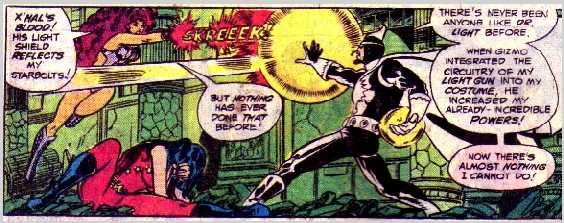 Supposedly, what DC and Meltzer were
trying to do here was to “explain” why Light became a goofy villain
post-1982, when Marv Wolfman started to depict him in a more jokey
manner within the pages of New
Teen Titans. But here’s where they fouled up themselves:
when Green Arrow discusses Dr. Light with Wally, the Flash argues
that he “always thought he [Dr. Light] was a moron.” Except that in
his first 3-4 appearances in NTT, Dr. Light was still as effective
as he’d been before then, as even Starfire could’ve confirmed, since
she battled him up front and heard his dialect too, so it simply
doesn’t make any sense to write Wally as saying that he’d always
thought that this once-enjoyable villain as a “moron”, in the case
of this book meaning that he was supposedly always a clown. In fact,
it totally obfuscates the fact that his very own uncle, who was once
menaced by Light within the pages of the Flash itself, would surely
have told him all about their battles together, ditto much of the
rest of the JLA and DC superheroes, and why would they have lied to
him? Not to mention that Wally did tend to watch the TV news
broadcasts and read some newspaper reports, including his own
aunt’s, and would’ve known more than a thing or two about what Light
was like that way too. And most importantly of all, the Titans, like
virtually every other team group, have files stored on just about
every super-villain in the DCU, and would therefore have a
considerable amount of knowledge available about these many
adversaries.
Supposedly, what DC and Meltzer were
trying to do here was to “explain” why Light became a goofy villain
post-1982, when Marv Wolfman started to depict him in a more jokey
manner within the pages of New
Teen Titans. But here’s where they fouled up themselves:
when Green Arrow discusses Dr. Light with Wally, the Flash argues
that he “always thought he [Dr. Light] was a moron.” Except that in
his first 3-4 appearances in NTT, Dr. Light was still as effective
as he’d been before then, as even Starfire could’ve confirmed, since
she battled him up front and heard his dialect too, so it simply
doesn’t make any sense to write Wally as saying that he’d always
thought that this once-enjoyable villain as a “moron”, in the case
of this book meaning that he was supposedly always a clown. In fact,
it totally obfuscates the fact that his very own uncle, who was once
menaced by Light within the pages of the Flash itself, would surely
have told him all about their battles together, ditto much of the
rest of the JLA and DC superheroes, and why would they have lied to
him? Not to mention that Wally did tend to watch the TV news
broadcasts and read some newspaper reports, including his own
aunt’s, and would’ve known more than a thing or two about what Light
was like that way too. And most importantly of all, the Titans, like
virtually every other team group, have files stored on just about
every super-villain in the DCU, and would therefore have a
considerable amount of knowledge available about these many
adversaries.
One of the biggest problems with the part involving the rape,
besides the fact that Sue is not allowed a genuine voice of her own
in all this matter, is that it doesn’t even describe it specifically
as an act of rape. And that’s one more reason as to why anyone could
find it offensive: because it's so superficial in its approach to
the subject, and so otherwise unclear, that as a result, it
trivializes Sue's victimization, and renders the whole part more
plot device than anything else. And it pretty much explains one of
main reasons why I was turned off by it.
Not only that, but it also pretty much trashes a once good villain
in comics rather than to fix him: now, while he may rate as a cool
villain to some, others could turned off of any book featuring Dr.
Light out of revulsion. It wouldn't matter even if he were
possessed, it's the character with the funny looking goatee whom
people would see as having committed the deed against Sue Dibny, and
new readers would probably be the most leery of reading about the
character. It also makes no sense when you take into consideration
that Dr. Light never did things like rape before, and so to just
shoehorn this into past history without any genuine evidence that he
was ever a pervert before is in 3 words - out-of character. And what
next, will Marvel's Taskmaster and the Vulture be the next ones to
undergo such a tarnishing? Or even DC's Felix Faust and Professor
Ivo? The Turtle in The Flash #213 has already fallen victim to
something almost similar.
Worse, by using what is more or less a cartoon character wearing a
costume as the rapist in IC, Meltzer has actually taken away much of
the seriousness of the subject. Imagine one of the villains from
Warner's Looney Tunes in such a role: would anyone else be able to
take it seriously if Yousemite Sam did that?
When Denny O'Neil wrote Green Lantern/Green Arrow back in the 70's,
the advantage was that he used realistic villains without any
costumes in many of the stories, and that's what made them work so
well.
Simply put, when dealing with what happens to be a serious subject
like rape, you can't just go along and use a costumed character as
the culprit in such a case, most certainly not one who's never been
written as such a thing before, because it destroys the credibility
of the story. I don't know if Denny could write it better, but if he
used the same skills in a case like this, I'm sure it'd come off
much more convincingly.
When it comes down to what IC features, such topics as rape only
work well if there's genuine educational value to be found in the
story, and if it affects the victim's personality and character
development. And if it's done as a contemporary story development,
that's what makes it really work out well.
Sad to say, with the way that Identity Crisis is done (or rather,
isn't), that's exactly why it doesn't work. And even if repairs are
made, the problem is that it sticks in embarrassment. In fact, if
any toy action figures are being built now of Dr. Light, who knows
if any sensible parent who's aware of the goings-on in this
miniseries are going to want to buy their children a toy action
figure of a character who's been made out to look like a rapist?
Does Identity Crisis finger the
victims as the ones to blame?
Another leading problem I have with it is that it seems to imply
that Sue's death is all the fault of the heroes for the actions they
took against Dr. Light, and maybe even other villains as well, whose
record is far less by comparison: in other words, they "took his
mind" and then got repaid for their actions by having a beloved lady
suffer for their actions. And when I look at some of the questions
being raised by the readers, about what Sue herself was doing aboard
the sattelite station, whether or not it turns out to be the case,
it seems to be implied that Sue "did something to deserve it". Which
is what's called "blaming the victim", and it makes me shudder
whenever I see that dirty tactic being used.
In any case, they've done it already with the rest of the
superheroes who took part in the mind-wiping on Dr. Light. Quite the
opposite of a good lesson featured in the Avengers two years ago,
when Capt. America assured Carol Danvers that Kang's and the Master
of the World's evil deeds were their crimes, not hers.
Being familiar with Amazing Spider-Man's 9-11 issue from 3 years
ago, I remember that there was a suggestion similar to what seems to
be featured in Identity Crisis over there too, that it was all the
fault of the victims, and here too, it seems to be featured, only
more metaphorically.
And, scarily enough, the possibilities that this is a metaphorical
act of Chomskyism and anti-Americanism – not to mention an attack on
Israel as well – may not be too far off. In other words, it would
seem as if Sue Dibny is meant to take the place of the World Trade
Center towers, and the superheroes are stand-ins for the US security
representatives, or the government itself. And not only that it
would seem as if, presumably, what the author is trying to tell us
is that Sue was attacked because of past actions of the US against
dictatorial countries like Iran and Iraq (the latter which is
hopefully coming out from under that curse now since 2003), by
imposing sanctions upon them and supposedly not listening to their
voices. And what this bigoted little book is apparently trying to
tell us is that it was not, and never was, the terrorists of the
al-Qaeda who were to blame for the act of evil inflicted upon
America, but rather, the past actions of America against other
supposedly innocent nations by trying to suppress them for
supposedly no good reason. This is pretty much alluded to when Dr.
Light shouts at the heroes, “You. Took. My. Mind.” This is no doubt
meant to resemble a terrorist falsely accusing the goodies of
“taking his and his fellow terrorists’ freedom”. And of course, it
totally ignores whatever crimes the culprits themselves committed
that led to these actions, which more or less is legitimizing them.
Even more scary however, is how the rape's being swept under the rug
is shockingly similar to how the world media largely ignored the
brutal murders of the Wall
Street
Journal
reporter
Daniel Pearl and even another American citizen named Nick
Berg,
a
native
of Philadelphia, by terrorists in Iraq and Afganistan. Both
men were brutally murdered by beheadings, yet their murders were
largely trivialized and ignored by an uncaring media, which
preferred to sweep their tragedies under the rug and pay full
attention to what happened in Abu Graib, instead.
As mentioned before, there is reason to assume that this book is
also an attack on Israel, and it was after finding this
article
from
the
Forward
weekly that I began to realize that it could be even worse
than I thought.
And specifically, it was this part here that alerted me to the
possibilities:
“As a Jewish writer, Meltzer says that
his own cultural heritage comes into play, not only in "Identity
Crisis" but in all his works, as well.”
No kidding. I guess that could explain why, in a television series
he co-created in 2004 called “Jack and Bobby”, a Jewish character
refers to his mother not as Jewish, but as “nothing”, and only his
father, who’s Catholic, is described as something: As he asks of a
rabbi in a synogogue, if his mother is nothing and his father is
Catholic, who and what is he?
I don’t even want to think about what the rabbi the Jewish character
was consulting with said in response to that.
Peter Sanderson, a comics historian who writes for IGN, rightfully
panned Identity Crisis as misogynistic. While as for me, I pan
Jack and Bobby as an act of Jewish self-loathing, and, come to think
of it, IC as well: it doesn’t take a genius to figure out here,
especially given that a most respectable Jewish editor, Julius
Schwartz, was behind their creation, that the women of DC are meant
to be stand-ins for Jewish – and even Italian – protagonists. As Bob
Rozakis once pointed out, in fact, Jean Loring’s first name is also
that of Schwartz’s own wife.
What does this mean, in other words? That aside from the fact that
women here are largely – and strangely – silent and have no
voice/opinion of their own in the whole affair, are being used as a
metaphorical attack on Jewish and even Italian women?
Somehow, that’s what I was thinking might be possible when I saw how
Zatanna was assaulted by Deathstroke, who was in the story for
nothing more than to serve as a plot device, and nothing else. As
was established by Gerry Conway in Blue Ribbon Digest in 1980, in a
special backup story that told the origin of Zatanna’s father,
Zatara, their family was from an Italian background. But because she
(and even her father) could just as easily pass for a Jewess, that’s
why I couldn’t help but wonder if the part where Slade Wilson
punches her in her cute little tummy, causing her to belch (!), was
in any ways meant as a stereotypical attack on Jewish women. It’s
because I had once seen a movie called Keeping the Faith (which
didn’t, to say the least), and that film contained an insulting joke
in which rabbi Ben Stiller’s date invited him to bomp her in the
tummy so she can show him how sturdy and fit she is. He knocked her
over on the floor.
In a way, the gruesome scene in this miniseries reminded me
chillingly enough of that same movie scene those couple of years
ago, and made me fear that it could be imitating the very same
stereotypical insult previously featured. But it’s also insulting,
and in fact, offensive, to Italian women as well. And totally
disrespectful of classic characters who were given as a gift to the
public by people who cared many decades ago too.
Sales through inappropriate style
of art?
As mentioned earlier, I once had an argument with a very weird
person online who said, much to my bewilderment, that “glam art”, as
he put it, was perfectly okay for the cover, and that the company
needs to do what they can sell the book.
The cover artist, to say the least, was Michael Turner, a notable
good girl artist, and that he should be the one chosen to draw the
covers was a bit odd, and while I’m sure that Turner is a decent man
himself, and I do like his artwork for Supergirl (whose return to
the DCU got considerably less attention press-wise than IC did), I
cannot say that it’s very appropriate for even the cover of a book
containing a serious subject, and therefore counts as a publicity
stunt, just like the book itself.
Yet that mattered not to my silly, totally devoid of any moral or
common sense opponent in an argument, who then tried to ignore my
pointing out to him that what he said was potentially offensive, and
instead insisted that the cover was not pornographic, as if I ever
said it was. Ignorance is strength, eh?
Why Zatanna but not Green Lantern?
The miniseries’ would-be purpose was to criticize what I assume the
writer personally, not generally, feels was an inappropriate action
by the heroes against the villains, which was to erase their
memories of finding out their secret identities.
While it’s true that it wasn’t altogether an appropriate action that
the heroes took in the Silver Age, the problem here lies in the
political undertones this was apparently being done for the sake of:
to say the least, the use of mindwiping here appears to have been
done as an analogy to abu-Ghraib in Iraq, or, as mentioned earlier,
America’s supposed oppression of countries like Iran as well as
Iraq, ditto Israel’s supposed oppression of the “poor palestinians”,
while ignoring/absolving their acts of cowardly terrorism against
defenseless Jews via suicide bombings, and suppressing that info
from the public at large, as the biased media does.
But aside from that, what I don’t get here is why Zatanna is
depicted as being the one who’s dealing with the mind-wiping, and at
the behest of the men (not that it matters to the writer, she’s
still a culprit in his viewpoint for that): she conducts the
process, as much a failure as it is, and is pegged as the one in
charge of other erasures as well, certainly in a case involving the
Secret Society of Super-Villains, which isn’t even in continuity
anymore, to say the least (but which matters not to Mr. Meltzer,
since the story MUST be told at any cost). What about Green Lantern
Hal Jordan, who certainly was responsible for more than a few
mind-wipes of his own, much more, in fact, than Zatanna is claimed
to be in here. During the Silver Age, he committed quite a few
erasures of both guilty and innocent people, and was certainly
implied as doing so in several other cases as well. But here, almost
nothing seems to be made of it. Is it because Hal’s returned from
the dead, and DC cannot afford to dampen the enthusiasm (they did
anyway), or, is it because the writer wants to further his own bias
against women?
To say the least, while Zatanna did do a few mind-wipes of her own
in the past, it was very few times, and certainly less than Hal
Jordan ever did. So to say that she did it the way things were
handled here is to exaggerate her own actions and deeds, and to
defame one of the most delightful characters in DC history.
Hawkman – defamed and cheapened
But lest anyone think that just the women here come off badly, even
Hawkman does too, by showing him taking part in the mind-wiping of
Dr. Light. To say the least, this has the effect of cheapening even
the work of Geoff Johns and James Robinson on the fourth volume of
Hawkman, and makes him look like a cad.
There’s more about all the characters involved, but it’ll be left
for another column.
The killer was of the same sex!
The final nail in the coffin for this miniseries, however, was in
the most anti-climactic ending, when Jean Loring, the former wife of
the Atom, pretty much gives away that she was the killer, simply by
blurting out a line that implicates her in doing so. And not only
that, it appears that her reasons for doing so were because of –
insanity. Surprise, surprise.
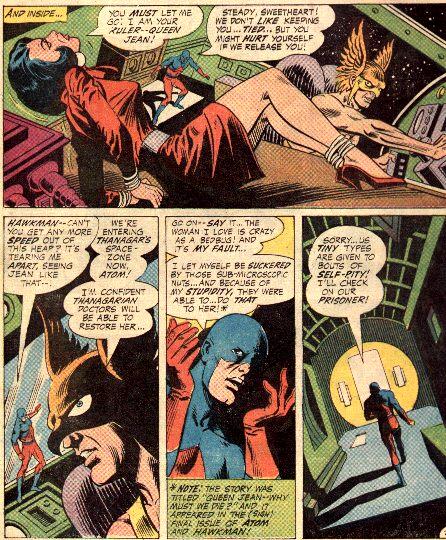 The most interesting thing here is
how, while Jean did suffer 2 times from madness years before, caused
by villains who’d captured her at that (see The Atom and Hawkman #45 from
1969, and Super-Team Family #13,
from 1977, for two examples), there is no mention whatsoever of
those past incidents of yore, and the resulting effect is that the
reader has no clear understanding of if or how Jean went insane
before. If anything, the way it was done here makes it look almost
as if Jean had just gone insane only a few years ago, without having
anything to do with her past experiences, and as if it hadn’t even
happened before, or, as if it were something new that just happened.
The most interesting thing here is
how, while Jean did suffer 2 times from madness years before, caused
by villains who’d captured her at that (see The Atom and Hawkman #45 from
1969, and Super-Team Family #13,
from 1977, for two examples), there is no mention whatsoever of
those past incidents of yore, and the resulting effect is that the
reader has no clear understanding of if or how Jean went insane
before. If anything, the way it was done here makes it look almost
as if Jean had just gone insane only a few years ago, without having
anything to do with her past experiences, and as if it hadn’t even
happened before, or, as if it were something new that just happened.
If you think that the above sounds confusing, it is, and if
anything, it’s as if the writer were trying to just use the fact
that Jean had been depicted as having gone insane before as a
justification for actions, without having anything at all whatsoever
to do with her past experiences.
Like I said before, it’s as baffling as it sounds.
The most ridiculous thing about the revelation of Jean Loring as a
killer was how she was depicted as using a flamethrower – I kid you
not – to try and destroy the evidence of her having killed Sue Dibny
via a brain bleeding infarction. It was so cartoonish, in fact, that
if I didn’t know better, I would’ve fallen off the couch laughing.
But I won’t. It’s not funny, and in fact, it’s obscene.
Not to mention that this is where the miniseries commits what seems
to be a common trick among many disinterested writers these days:
destroy all credibility and throw it out the window. For example:
Just how did Jean even know that Sue’s memory had been erased? To
say the least, aside from the fact that there is no evidence in past
DC history to even so much as remotely suggest that the heroes were
ever hiding any kind of a secret about a rape that supposedly took
place, it’s pretty apparent that Atom never even told her, or that
any other people close to the superheroes in the DCU ever knew
either. Not only that, but, how exactly does she know each and every
secret identity in the DCU? Just one of more than few plot holes
left unexplained in this travesty, and it was so stupid, it was
virtually stupefying to boot.
Speaking of which, the most troubling part in all of this was – how
exactly did Jean know who Tim Drake was? There is no evidence of her
ever having actually known his own family name, or who he was, and
given that his ID as Robin was a well-guarded secret, and Batman for
the most part forbids him to tell his real name (instead, he usually
goes by the pseudonym of Alvin Sharp), most certainly not in public.
Not to mention that the heroes addressing themselves by their first
names, if anything, during the funeral seemed very contrived, and
it’s unlikely that the heroes would ever divulge their secrets in
any ways, certainly not if there’s a maniac on the loose looking to
get at them.
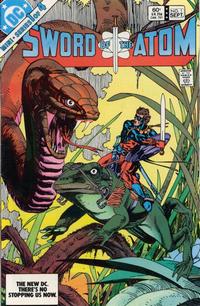 And if there’s any most glaring hole in the
way the story is depicted here when it comes to both Atom and Jean,
it’s that it implies that Ray left her, when in past history, it was
JEAN who left the
Mighty Mite, and NOT the other way around. It was in the acclaimed
miniseries, Sword of the Atom, in 1983, written by Jan Strnad and
penciled/inked by Gil Kane and Dick Giordano, that the developments
took place, when Ray found out that Jean was cheating on him with
Paul Hoben, a lawyer who worked at the same law firm that she did,
and while he tried to forgive her for her extramarital affair and
reconcile, it didn’t work out (mostly because he in turn had fallen
in love with the princess Laethewan of the tribe of little humanoids
called Katarthans he’d encountered in South America), and they ended
up getting divorced, and Jean married Paul – complete with Ray’s
blessing too. (For more, check out
this article from the old Fanzing website.)
And if there’s any most glaring hole in the
way the story is depicted here when it comes to both Atom and Jean,
it’s that it implies that Ray left her, when in past history, it was
JEAN who left the
Mighty Mite, and NOT the other way around. It was in the acclaimed
miniseries, Sword of the Atom, in 1983, written by Jan Strnad and
penciled/inked by Gil Kane and Dick Giordano, that the developments
took place, when Ray found out that Jean was cheating on him with
Paul Hoben, a lawyer who worked at the same law firm that she did,
and while he tried to forgive her for her extramarital affair and
reconcile, it didn’t work out (mostly because he in turn had fallen
in love with the princess Laethewan of the tribe of little humanoids
called Katarthans he’d encountered in South America), and they ended
up getting divorced, and Jean married Paul – complete with Ray’s
blessing too. (For more, check out
this article from the old Fanzing website.)
And while unsuccessful then in reconciling with her, Ray begged her
to take him back, and always left the door open for her to return if
she wished. And it just goes to show how big a hole in the story is
created in Identity Crisis, by having Jean trying to do something to
make Ray come back to her, by sending everyone on a wild goose
chase, when here, all she had to do was to ask Ray if he wanted to
get back together, and remarry. Simple as that. To switch things
around as is done in IC renders it all in the most horrifying of
stereotypical characterizations, of a jealous woman who despises
someone else's having a good marriage and even a forthcoming child,
and then goes and undoes that happiness, here in the sickest of
ways.
And that’s why the whole story is rendered silly and pointless, with
the rape, and various other red-herrings being made completely
irrelevant.
There’ll be more to come, in another
column that’ll be coming up soon.
Copyright 2005 Avi Green. All
rights reserved.
